


- Paul Tudor Jones called Bitcoin “unequivocally” the best inflation hedge, citing its fixed supply and scarcity compared with gold.
- The billionaire investor warned that current S&P 500 valuations point to weak or negative 10-year forward returns.
- Jones said a major equity market correction could pressure U.S. tax revenues, widen the federal deficit, and weigh on the bond market.
Billionaire investor and macro trader Paul Tudor Jones has described Bitcoin as the strongest hedge against inflation, arguing that its fixed supply gives it an advantage over gold and other traditional stores of value.
Speaking on the Invest Like the Best podcast with Patrick O’Shaughnessy, Jones said Bitcoin was one of the clearest “knockout opportunities” he has seen in markets, particularly during periods of aggressive monetary and fiscal stimulus.
“Bitcoin is unequivocally the best inflation hedge that there is — more than gold,” Jones said, pointing to the cryptocurrency’s hard-capped supply as its defining feature.
Bitcoin’s fixed supply strengthens its inflation hedge case
Jones said Bitcoin’s scarcity is what separates it from gold. While gold supply increases annually, Bitcoin is capped at 21 million BTC, with less than 1 million BTC left to be mined.
“Gold increases supply every year by a couple of percent. Bitcoin, there’s a finite amount that can be mined. It’s decentralized. And so in that sense, it has the greatest scarcity value of anything,” Jones said.
Bitcoin has so far gone through four halvings, which have reduced the initial 50 BTC block reward down to 3.125. The next halving, which is forecasted to happen in the first half of 2028, will drop this reward down to 1.5625 BTC. If we take a look at Bitcoin historical price data, we can see that BTC has managed to reach a new all-time high in each of its 4-year halving cycles.
The hedge fund manager first publicly backed Bitcoin as a hedge against central bank money printing in 2020, when he said he held between 1% and 2% of his assets in BTC. In 2021, he said he viewed Bitcoin as a portfolio diversifier and wanted to allocate 5% of his assets to the cryptocurrency.
Reflecting on the market environment after the March 2020 pandemic crash, Jones said the scale of intervention from the Federal Reserve and U.S. Treasury made inflation-focused trades more attractive.
“When you saw all the interventions… you just knew that the inflation trades were going to take off,” he said, adding that Bitcoin was the most compelling opportunity among them.
However, Jones also acknowledged risks. He said Bitcoin’s weakness as an inflation hedge could emerge during a major cyber conflict, where digital infrastructure comes under attack. He also pointed to quantum computing as a longer-term risk if future advances make it possible to compromise digital systems.
Jones warns U.S. equities may face weak returns
Jones’ bullish stance on Bitcoin contrasts with his cautious view of U.S. stocks. He warned that equity valuations appear stretched and said current S&P 500 levels suggest poor long-term return prospects.
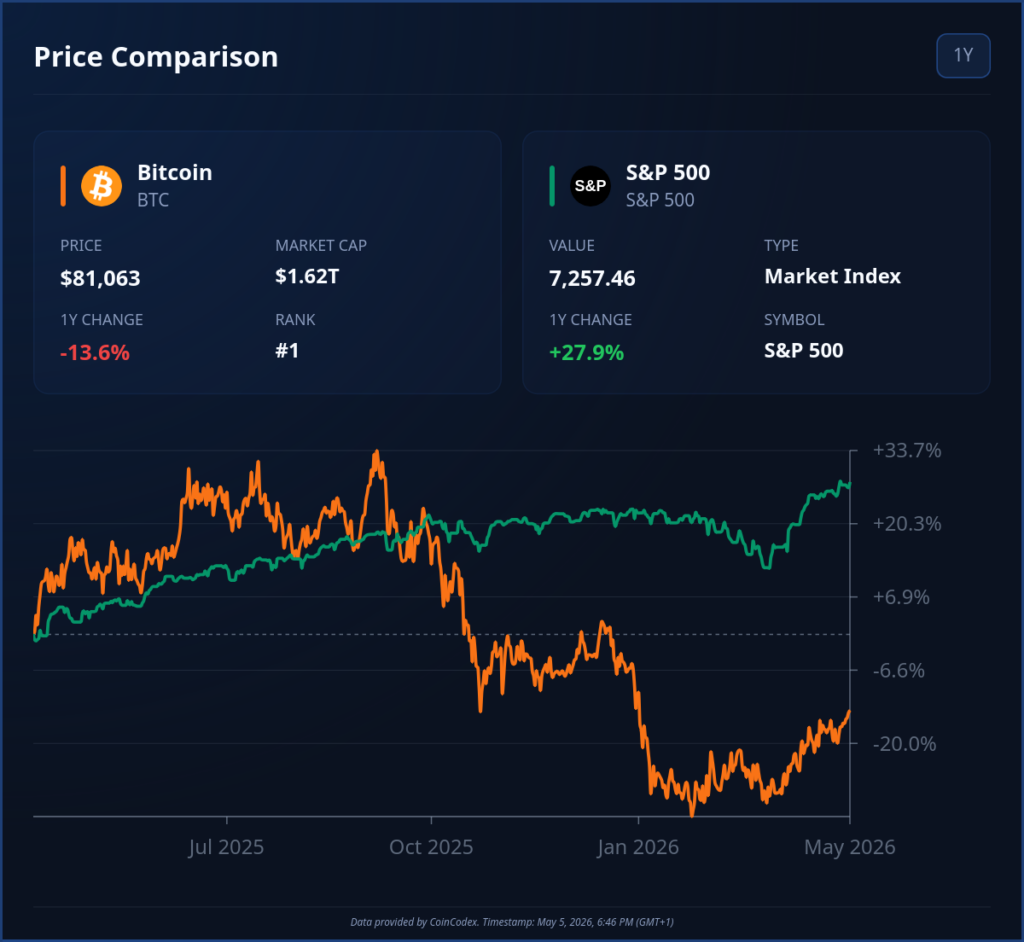
The S&P 500 (+27.9%) has significantly outperformed Bitcoin (-13.6%) in the last year.
“If you buy the S&P at this current valuation, the 10-year forward returns [are] negative,” Jones said. “It’s going to be really hard to make money from here.”
He also noted that U.S. stock market capitalization relative to GDP remains near historic extremes. Jones compared today’s levels with previous market peaks, including 1929, 1987, and the dotcom bubble.
“In 1929 we were, I think at the top, at 65% [stock market capitalization to GDP] and then in ’87 we got to about 85%-90%, in 2000 we got 270%,” he said. “And now we’re at 252%, so you can just imagine. We’re clearly so leveraged in equities in this country.”
Jones stopped short of calling the current market a full-blown bubble, but said the level of equity exposure in the U.S. economy could make any correction more damaging.
He also warned that a wave of potential initial public offerings, including companies such as SpaceX, OpenAI, and Anthropic, along with reduced corporate share buybacks, could increase the supply of equities and add pressure to prices.
Market correction could hit the U.S. budget and bonds
According to Jones, the risks from an equity downturn could extend beyond investors’ portfolios. He said a large stock market correction could reduce capital gains tax revenue, worsening the federal budget deficit and creating pressure in the bond market.
“10% of our tax revenues are capital gains. They go to zero,” Jones said. “So you can see the budget deficit blowing up. You see the bond market getting smoked.”
Jones described the potential chain reaction as a negative feedback loop that could deepen market stress.
“You can see this kind of negative self-reinforcing effect,” he said. “It’s troubling.”
While Jones’ comments underline his continued confidence in Bitcoin as an inflation hedge, they also reflect growing concern among some macro investors that elevated U.S. equity valuations leave markets vulnerable if liquidity conditions tighten or investor sentiment shifts.
What’s your Reaction?
+1
1

+1
0

+1
0

+1
0

+1
0

+1
0

+1
0