
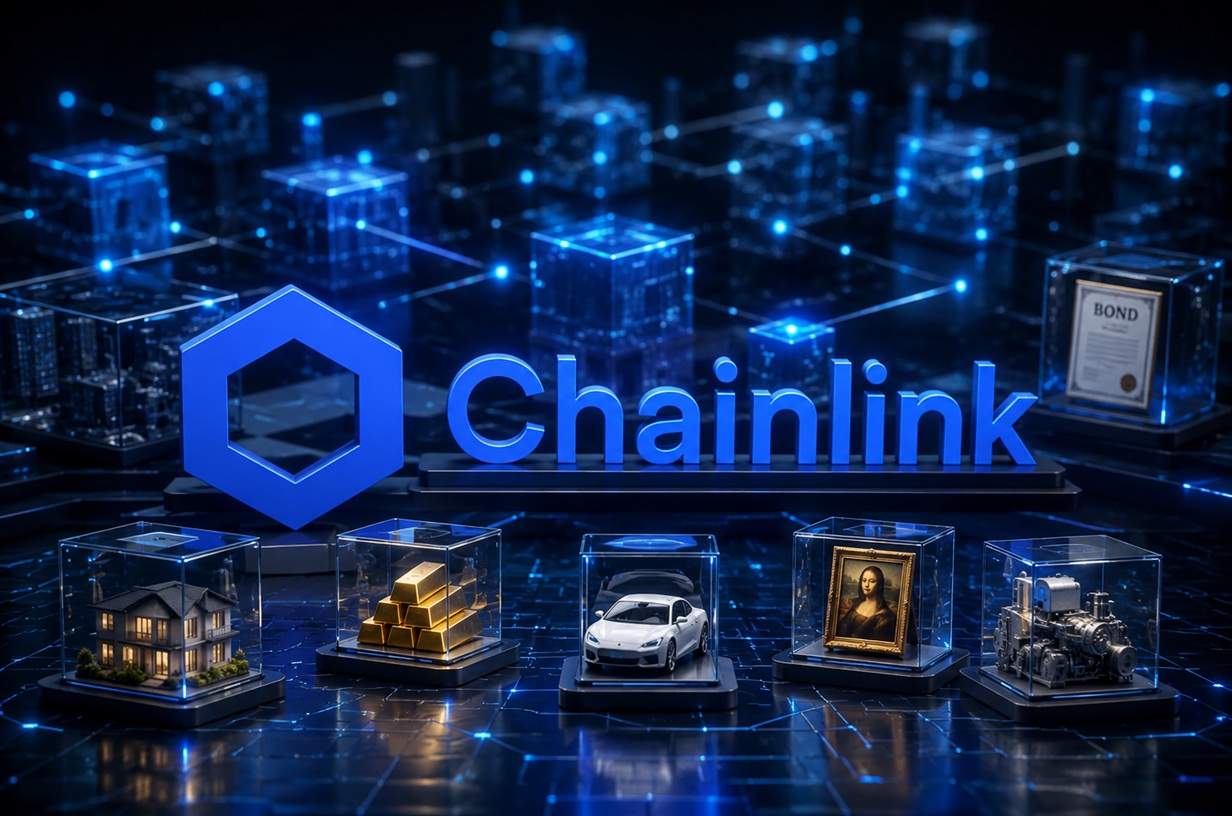
- Chainlink emerged as a layer solving the oracle problem in blockchains, which have isolated them from real-world data.
- The decentralized oracle network’s proof of reserve, runtime environment, compliance engine, cross-chain identity, data feeds, and cross-chain interoperability protocol work together to ensure the real-time delivery of real-world information to onchain smart contracts.
Blockchain code is immutable, but it’s far from being omniscient. Over the years, the technology has emerged as a fortress built on security, efficiency, and trust. However, it was a walled garden isolated from external data, making it fundamentally blind to real-world events.
Chainlink (LINK), a Decentralized Oracle Network (DON) and middleware layer founded in 2017, has risen to solve the “oracle problem,” which alienated blockchains and greatly limited their real-world adoption.
Blockchain’s Oracle Problem
The oracle problem refers to the inability of blockchains to access external data. Chainlink likened it to a computer without an internet connection. It’s also akin to a smartphone with a broken touchscreen sensor, which functions internally but has no way to interact with the user.
The situation traps smart contracts in a vacuum. Smart contracts may be designed to execute agreements flawlessly, but they are essentially useless without real-world context.
This creates a major roadblock for developers as they grapple with how to get timely, accurate real-world data into an immutable ledger without introducing a central point of failure.
The Rise of RWA Oracles
An oracle offers a secure bridge linking siloed blockchains to real-world data. It’s the layer that fetches external information and delivers it onchain, which serves as the basis for smart contract execution.
Oracles expand the capabilities of blockchains. They ensure precision in decentralized finance applications and protocols that are anchored to fluctuating market conditions, legal parameters, and off-chain values.
RWA (real-world asset) oracles are specialized oracles with multi-layered capabilities that focus on bridging traditional finance (TradFi) to decentralized systems. They allow legacy financial instruments, such as US Treasuries, commodities, real estate, private credit, and other RWAs, to be natively represented and actively managed onchain.
Chainlink’s Growing Role in RWA Tokenization
Chainlink stands out in the RWA sector with its all-in-one oracle platform providing rails for the end-to-end tokenization lifecycle. Unlike regular oracles, the network does not simply broadcast data; it also actively manages a tokenized asset.
The onchain tokenization lifecycle generally follows these phases:
1. Asset Evaluation and Deal Structuring
Before anything else, an institution must ensure that the asset it seeks to tokenize has established legal parameters and jurisdictional scope. The asset must have clear ownership rules, feasible valuation, potential for fractionalization, market participants, and a legal entity (such as a special purpose vehicle or SPV) for asset custody and management.
2. Minting, Proof of Reserve, and Smart Contract Deployment
Based on the established parameters, a developer embeds the rules into the token’s design. Meanwhile, the institution entrusts the physical assets under a qualified custodian. Then, the smart contract mints the corresponding digital tokens onchain.
The Chainlink Proof of Reserve (PoR) decentralized oracle automatically verifies the status of the reserves backing the tokenized assets. The audits occur in real time and provide cryptographic proof to prevent spam or infinite minting exploits.
By incorporating Chainlink Runtime Environment (CRE) into the initial phase of tokenization, institutions can immediately write programmable rules and compliance measures directly into the asset’s underlying smart contracts. It allows developers to enforce automated Know Your Customer (KYC), Anti-Money Laundering (AML), and other illicit finance restrictions from day one of the tokenization process.
Additionally, the Chainlink Compliance Engine (ACE) enhances the CRE’s capabilities at this stage. Built on top of CRE, it enables a unified compliance layer, connecting asset issuers, identity providers, risk-scoring platforms, and distribution channels. It streamlines configuration of compliance parameters, as the entire stack actively responds to even a single policy update in a central registry.
As a bonus, ACE can implement standards like Cross-Chain Identity (CCID) and Zero-Knowledge (ZK) proofs to address the “privacy paradox” typically hounding public blockchains. It lets institutions and market participants verify credentials, including KYC and AML status, accredited investor standing status, or jurisdiction, without exposing sensitive Non-Public Personal Information (NPI) or Personally Identifiable Information (PII) on a public ledger.
3. Distribution and Trading
Afterward, the institution distributes the tokens across market participants. From there, holders can trade them on secondary markets, like centralized or decentralized exchanges.
Chainlink Data Feeds, another institutional-grade decentralized infrastructure, delivers uninterrupted real-time market data securely onchain. It ensures that tokens maintain pricing accuracy that aligns with the value of their underlying assets.
4. Lifecycle Management and Corporate Actions
All the abovementioned elements come together to automate the administrative tasks related to tokenized RWAs. The CRE, in particular, enables tokenized assets to act as self-servicing financial instruments that autonomously execute administrative decisions.
CRE synchronizes real-world events and governance actions on- and off-chain to execute activities, including coupon payments, dividend distribution, and voting rights management, with precision.
Addressing Market Fragmentation
Amid the automation in tokenized RWAs’ end-to-end lifecycle, the global financial system suffers from the structural challenge brought by capital fragmentation. It usually stems from varied levels of regulatory restrictions across different jurisdictions.
Chainlink’s Cross-Chain Interoperability Protocol (CCIP) offers a universal messaging, identity, and capital routing standard across such fragmented markets. It uses a dual-network framework with a Risk Management Network to validate transactions across multiple blockchains.
Furthermore, the platform enables tokenized assets to move and be used across ecosystems, unlocking deeper liquidity and broader use cases, including but not limited to lending, collateralization, staking, and settlement.
What’s your Reaction?
+1
7
+1
0

+1
0

+1
0

+1
0

+1
0
+1
0