

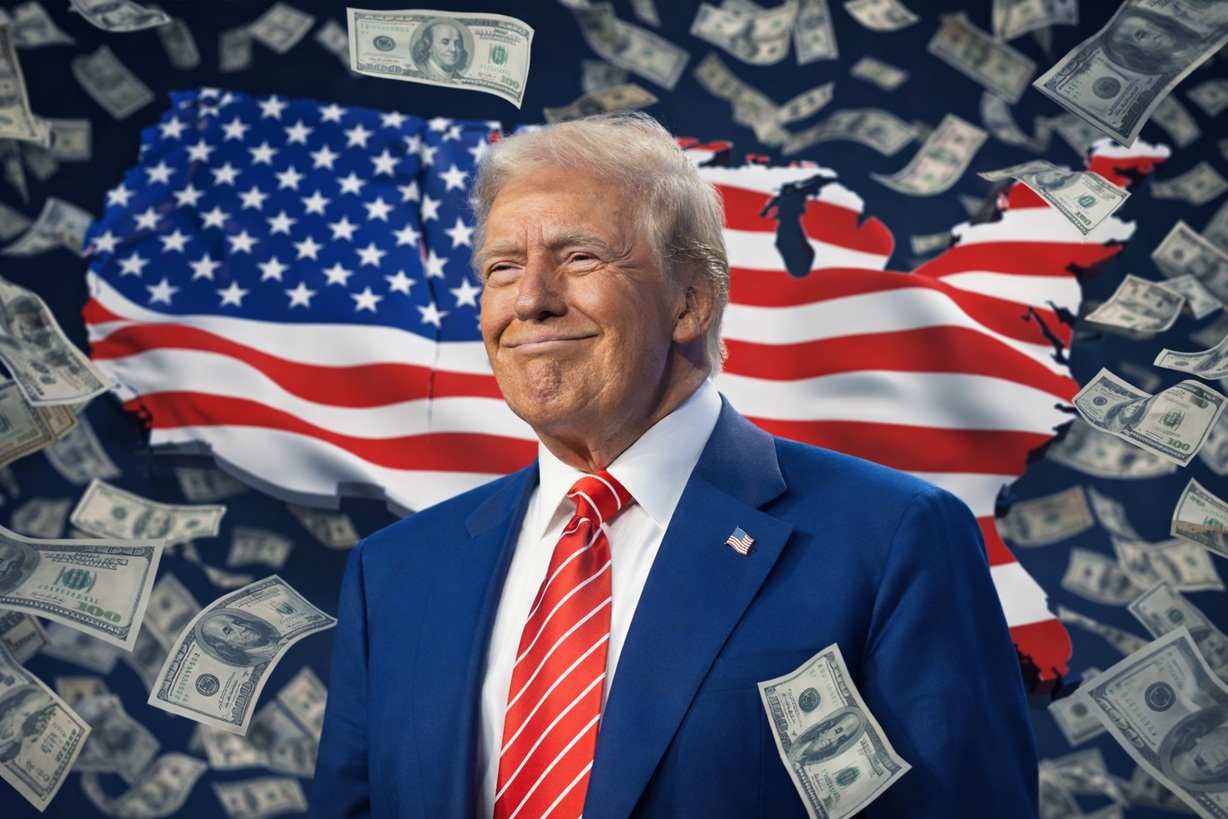
- The US Supreme Court’s ruling on Trump’s tariffs and the latter’s defiance are causing quite a stir in the market.
- Cantor Fitzgerald could potentially profit billions from the SCOTUS judgment.
The Supreme Court of the United States (SCOTUS) has struck down President Donald Trump’s broad emergency tariffs on imported goods. It opens the door to potentially massive refund demands from affected companies.
The president has defiantly unveiled his plan B, seeing the ruling as a clear affirmation of his inherent powers to steer the country’s trade and business deals with other nations. Meanwhile, Commerce Secretary Howard Lutnick’s family and associates reportedly knew what was coming.
Supreme Court Strikes Down Trump’s Tariffs
According to SCOTUSblog, the Supreme Court handed down the decision at a 6-3 vote. A majority of the justices declared that Trump has overstepped his authority using the International Emergency Economic Powers Act (IEEPA). The law enacted in 1977 grants the president the power to impose tariffs to sanction other countries.
Past administrations have notably utilized the same law to declare national emergencies since its enactment, but critics found Trump’s use of it to be overly aggressive. Hence, the opposition from small businesses and a group of states questioned the legality of the tariff-related presidential orders before the SCOTUS and sought a halt to the sweeping tariffs.
The SCOTUS didn’t address how the government should refund the unlawful tariffs to the aggrieved parties. However, it sent the case back to the Court of International Trade (CIT) to sort out such disputes.
The USDebtClock.org counter indicates that the US has raised over $374 million from Trump’s tariffs so far. Various sources estimate that the refunds could range from $175 billion to $200 billion.
Trump’s Response
Trump’s team seemed to have anticipated the unfavorable ruling. In a wild twist, the president defiantly invoked some provisions of the Trade Act to exercise his power to impose an additional 10% “global tariff” for all National Security-related items and tariffs unaffected by the latest SCOTUS ruling.
The administration also quoted Associate Justice Brett Kavanaugh’s dissenting opinion, which highlighted that the SCOTUS decision didn’t “substantially constrain a president’s ability to order tariffs going forward.” Kavanaugh argued that “numerous” federal statutes, such as specific provisions of the Trade Expansion Act of 1962 and the Trade Act of 1974, justify most, if not all, of the president’s tariff policies.
Lutnick’s Family to Gain From Potential Tariff Refunds
Before the SCOTUS judgment, Cantor Fitzgerald reportedly began buying the rights to several companies’ potential tariff refunds. It purchased their rights at roughly 20%-30% of their refund value.
It meant that if a company paid for $10 million in tariffs, it would only recoup $2 million to $3 million if it agreed to sell its refund rights. Meanwhile, the holders of refund rights, which is Cantor in this case, will collect the full government refund and can profit $7 million to $8 million per $10 million claim. Analysts suggest that Cantor stands to gain billions of dollars from the deal.
Although Secretary Lutnick has already divested his stake in Cantor, his sons, Brandon and Kyle Lutnick, could benefit from the negative SCOTUS ruling.
Short-Term and Long-Term Effects on Crypto
The latest developments offer mixed sentiment on crypto industry outlook. Several members of the crypto community, including Egrag Crypto, consider the SCOTUS ruling and Trump’s response significant catalysts for additional short-term uncertainty.
Nonetheless, they are confident that the market will always adapt, as the structural integrity of top digital assets, namely Bitcoin (BTC), Ethereum (ETH), and XRP, remains strong amid prevailing macro bearish pressure and the expected crypto winter based on the traditional crypto four-year cycle.
What’s your Reaction?
+1
4

+1
1

+1
0

+1
0

+1
0

+1
0

+1
0