
- Former Binance CEO Changpeng Zhao admitted that too much transparency is hurting crypto users.
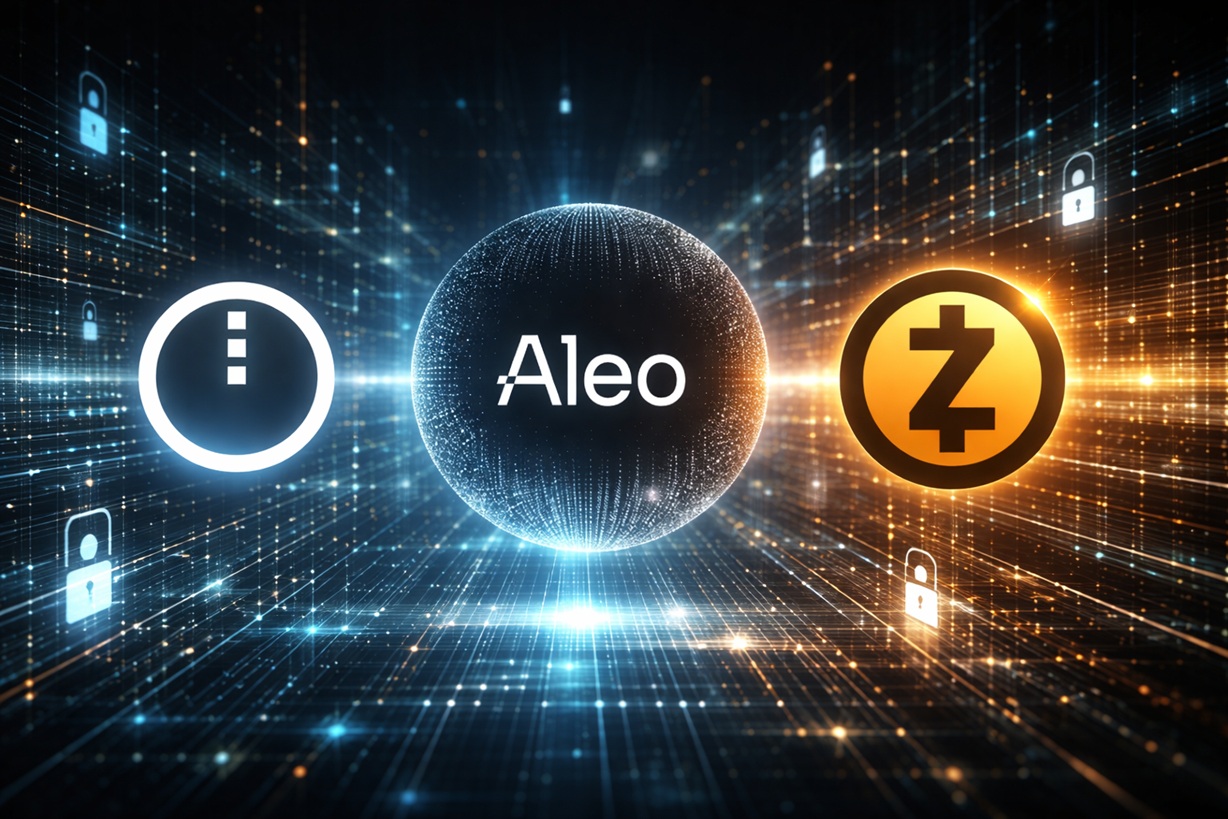
- Midnight, Aleo, Oasis Network, and Zcash are currently addressing the privacy dilemma that is preventing broader institutional adoption of blockchain and crypto.
Transparency used to be one of the key selling points of cryptocurrencies. However, as it blurs the boundaries with traditional finance, many have found that too much of it poses a serious problem.
Changpeng “CZ” Zhao, founder and former CEO of Binance, recently confirmed that too much transparency is hurting crypto users.
Ex-CEO Of Binance Confirms Privacy Is The Biggest Concern In Crypto
In an interview he shared on his social media account, Zhao admitted that transparency is making it “extremely easy” to track crypto funds. Tracing funds is much simpler when transactions are conducted on centralized exchanges and are coupled with Know Your Customer (KYC) protocols enforced by various regulators.
One situation CZ cited is when a company pays its employees and does fund transfers to other institutions using blockchain. People can search the company’s crypto wallet address in a blockchain explorer to see the other addresses it transacted with in the last week. From there, they can find even the employees’ salaries.
Another example is when a person pays for a hotel accommodation in crypto. Other people can see it and create security issues.
The former Binance CEO’s statement caught the attention of Charles Hoskinson, founder of Cardano (ADA) and Midnight (NIGHT). He suggested a tie-up with BNB and NIGHT to address crypto’s inherent privacy challenges.
Previously, Hoskinson claimed that many chains and cryptocurrencies have been solving the wrong problems. It has prevented their widespread adoption, particularly by institutions.
Besides simplicity and a more rule-based approach, Hoskinson believes privacy is one of the “missing links” to blockchain technology’s widespread adoption.
Top L1 Blockchains and Crypto with Native Privacy Solutions
To solve the transparency dilemma CZ cited, the industry is shifting toward integrating privacy features into Layer 1 (L1) chains, enabling them to move beyond the quandary of going “fully public” or “fully dark.”
To date, leading L1 solutions have introduced elements functioning as selective disclosure via Zero-Knowledge Proofs (ZKPs). The function prevents oversharing of details about a transaction to the public. At the same time, it remains compliant with regulators through a mechanism like a View Key operation.
Here are the top L1 chains currently tackling this dilemma:
1. Midnight (NIGHT)
As Hoskinson suggested, Midnight is a primary contender in this space. Launched on mainnet in March 2026, Midnight operates as a data-protection companion chain, or sidechain, to Cardano.
NIGHT’s tech utilizes ZKPs to separate data from computation. Unlike Monero (XMR), which is private by default and often clashes with regulators, Midnight allows for “Selective Disclosure.”
In the context of CZ’s example, this means a company could pay salaries privately while generating a specific “audit key” for tax authorities to verify the transaction without making the data public to competitors.
As of writing, NIGHT has a circulating supply of 16.6 billion tokens and a market cap of over $645 million.
2. Aleo (ALEO)
Aleo has emerged as a powerhouse for private programmable Web3. It is the first L1 to offer full programmability, like Ethereum (ETH), with privacy as the default.
The chain uses a specialized language called Leo and off-chain execution. Instead of the network seeing one’s data, the device performs the calculation and only sends a “proof” to the chain that the transaction is valid.
The solution solves the payment issue CZ mentioned. A person can prove payment for a product or service without anyone watching the chain discovering the entire wallet balance or transaction history.
Circle, a leading regulated stablecoin issuer, notably launched a pilot of the privacy-focused version of USDC using Aleo in December 2025, demonstrating Aleo’s huge potential for the future of on-chain institutional finance.
ALEO has 1.02 billion tokens in circulation, with a market cap of $51.67 million.
3. Oasis Network (ROSE)
Oasis integrates artificial intelligence (AI) and privacy. It basically leverages the key narratives shaping crypto finance in 2026.
The chain’s Sapphire runtime is the only confidential EVM (Ethereum Virtual Machine) in production. It uses Trusted Execution Environments (TEEs), which act like a “black box” for data.
The solution allows developers to migrate existing Ethereum apps to a private environment with almost no code changes. The feature makes it a go-to for decentralized finance (DeFi) apps that want to hide “whale” movements from front-running bots.
Oasis has 10 billion ROSE in circulation, with a market cap of $82.39 million.
4. Zcash (ZEC)
While an older player, Zcash remains relevant in 2026 by positioning itself as a “banker’s choice” when it comes to privacy. Among the big players betting big on ZEC are Winklevoss-backed Cypherpunk and Bitwise.
Zcash pioneered zk-SNARKs, the technology many newer chains now use. The solution offers “Shielded Addresses.”
For the corporate fund transfers CZ described, Zcash provides the most battle-tested infrastructure for institutions to move money without revealing their alpha or strategic moves to the public.
Zcash has 16.62 million ZEC tokens in circulation, with a market cap of $6.07 billion.
Disclaimer: The compiled data, analysis, and commentary featured in this article are only for informational purposes. They do not constitute financial advice or a product recommendation from the author or the Blockzeit team.
What’s your Reaction?
+1
1

+1
0

+1
0

+1
0

+1
4

+1
0

+1
0