

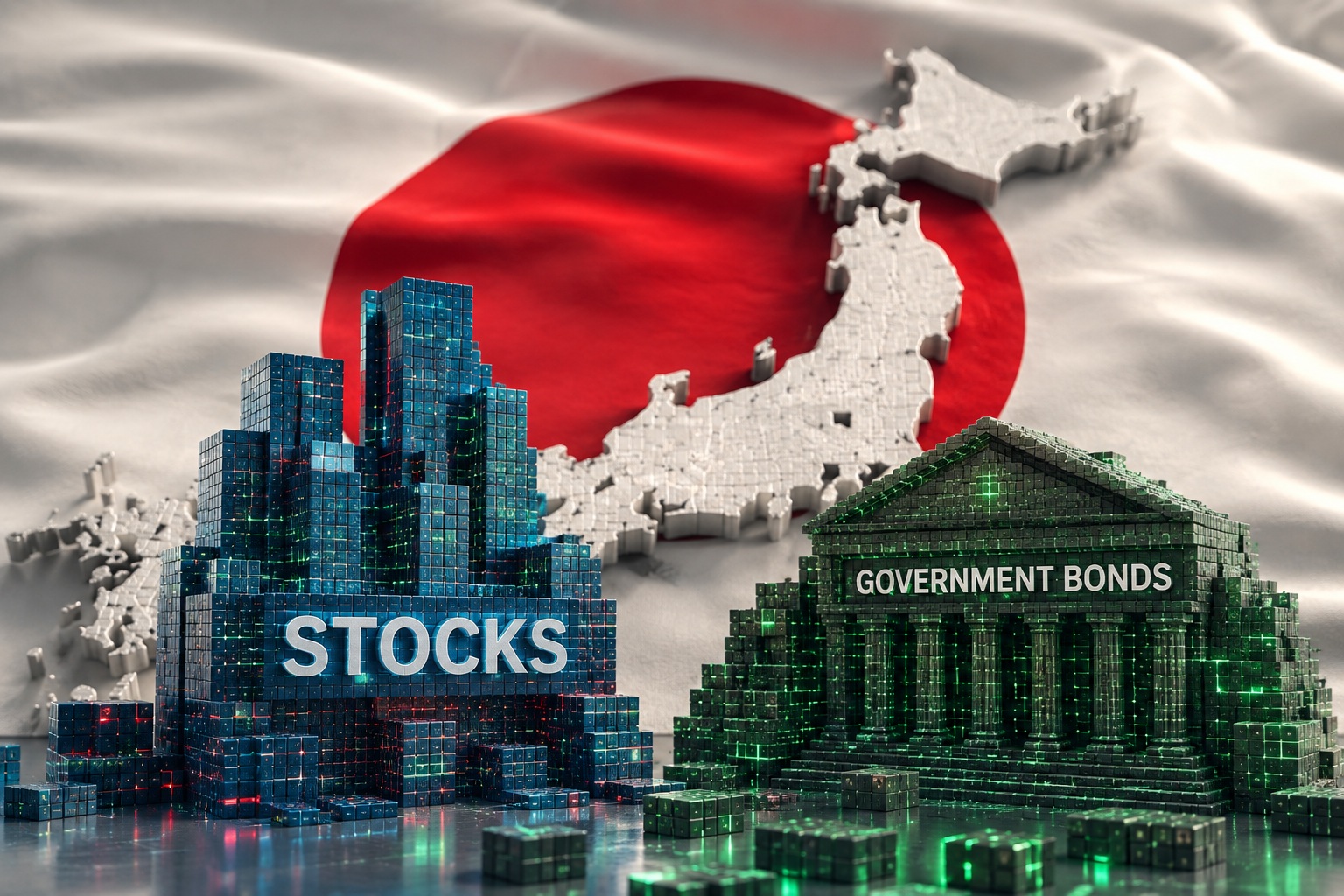
- Japan’s regulator, finance ministry, and central bank are in talks with financial institutions to explore integrating blockchain into stock and bond settlements.
- The country’s budget indicates it plans to issue ¥29.6 trillion in new sovereign government bonds in fiscal year 2026.
- Tokyo and Nagoya exchanges processed ¥3.39 quadrillion in the last fiscal year.
Japan, one of the world’s largest economies by gross domestic product (GDP), continues its push to be at the forefront of the Web3 revolution. On Wednesday (JST), Nikkei Asia revealed that the Asian economic giant is leveraging real-world asset (RWA) tokenization to boost stock and bond settlements.
Japan’s Blockchain Initiative for Stock and Bond Settlement
According to the source, the Financial Services Agency (FSA), the Ministry of Finance (MOF), and the Bank of Japan (BOJ) have been working closely with financial institutions to study integrating blockchain technology to enable instantaneous, efficient settlement of stock and Japanese government bond transactions. The group aims to launch a study group by summer to craft a framework that would pave the way for a development plan as early as 2027.
The development plan will determine the blockchain model best suited to the new initiative. Additionally, it will identify the specific contributions and responsibilities of the government agencies and institutions involved in the project.
Moreover, the framework will establish a road map to guide the implementation of each phase of the program. If approved, the group targets a full system launch by the early 2030s. Participants also consider extending the initiative’s capabilities to include international remittances.
Why This Matters
Japan is the world’s fourth-largest economy and the second-largest in Asia-Pacific (APAC), with a GDP of $4.38 trillion. Reuters notes that Japan will issue approximately ¥29.6 trillion (roughly $190 billion) in new sovereign government bonds based on its 2026 fiscal year budget. It projects that the figures will inflate to ¥38 trillion by fiscal 2029. Meanwhile, Nikkei reports that Tokyo and Nagoya bourses have turned over a total of ¥3.39 quadrillion (around $21 trillion) in the last fiscal year.
The project’s realization is expected to significantly reduce friction in stock and bond settlement, allowing settlement in near real time and letting investors reinvest proceeds from asset sales in a short interval. Cash settlement for stock trades typically takes two days to settle after execution, while Japanese Government Bonds (JGB) settle a day after execution.
Furthermore, deploying these securities in a distributed ledger framework will make them available to investors 24/7, all year-round. Uninterrupted trading, free from the restrictions of traditional banking hours, is expected to boost trading volume and bring more domestic and international liquidity into Japanese markets.
What’s your Reaction?
+1
7
+1
0

+1
0

+1
0
+1
0

+1
0
+1
0